
The Middle-Class Indians Living in Ahmedabad’s Slums
Published:
This is the first post in a series documenting my observations from my fieldwork in Ahmedabad. As part of my master’s project on the impact of a community health worker program, I spent many months walking among and talking to the residents of five low-income neighbourhoods in the city.
“Aapne bhi dekhe honge, yahan sab middle-class log hi hain. Unko surgery karne ke liye paisa nahin hota hai.”
(You must have also seen—the people here are all middle class. They do not have enough money to get surgery.)
Manisha Ben’s* words caught me off guard on my one of my first visits to Ahmedabad’s slums. I had spent the preceding weeks reading research papers on healthcare access for the urban poor. And yet I had seemingly met the Indian middle class.
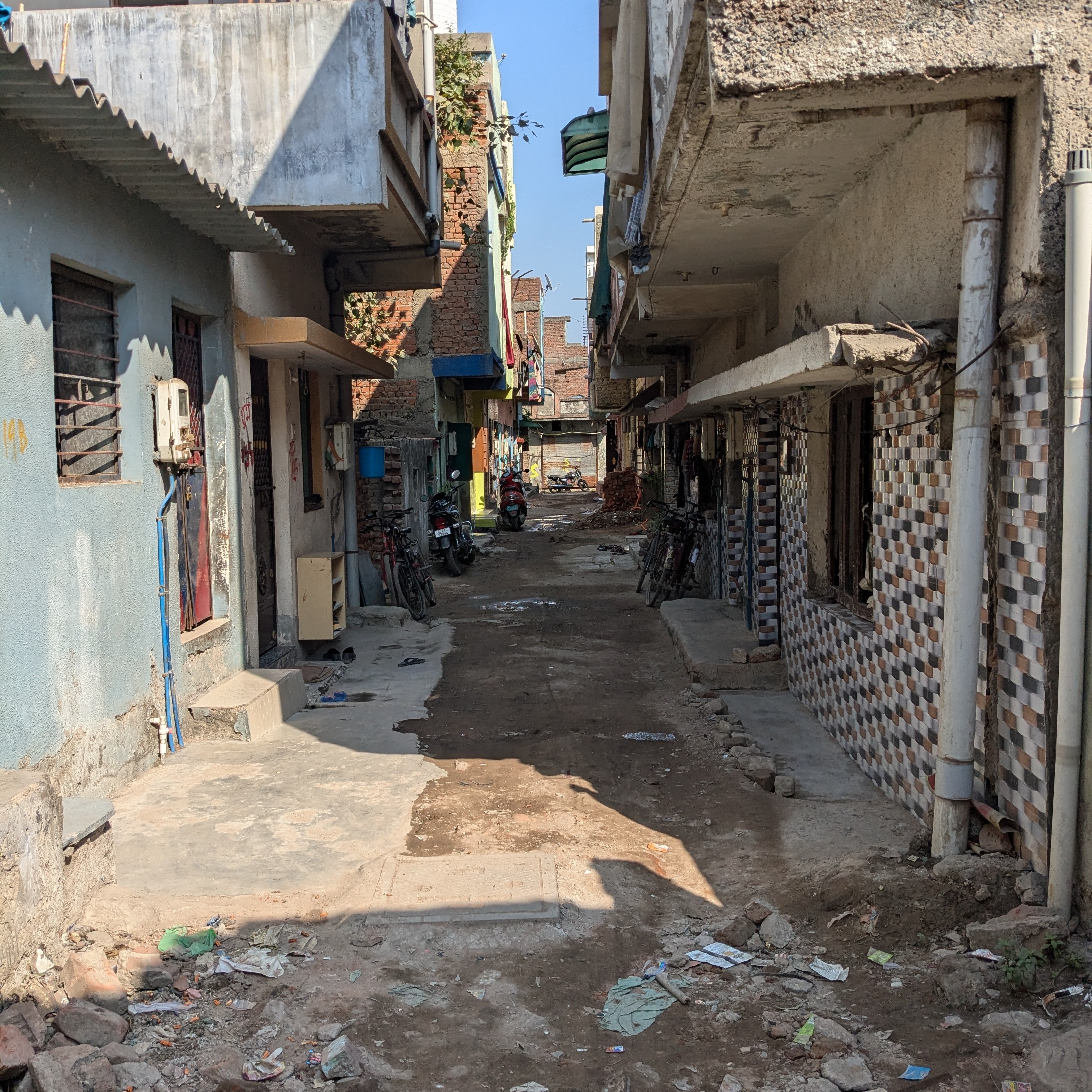
A lane in Shahwadi, Ahmedabad
This was far from an isolated incident. In the following months, I met as many patients who casually described themselves as middle-class and as those who claimed to be “gareeb” (poor). The self-identification as middle class by the very people who we (in academia) consider the urban poor did not sit well with me. What was the definition of the middle class?
Is it, as one of the patients put it when commenting on the unaffordability of surgery, “Hum middle class hain—hamare paas kapde dhone wali machine bhi nahin hai” (We are middle class—we don’t even have a washing machine.)
Economists have debated the best way to classify the middle class—with approaches using income-based thresholds, socio-cultural factors, or even the nature of employment. Among the many approaches, the one I find most interesting is perhaps the simplest—to just ask the people directly.
In a national survey carried out in 2014, three economists posed a straightforward question to a sample of Indians: “Do you consider your family to be a middle-class family?” Their results showed that 49% of Indians considered themselves to be middle class. What is more fascinating is how these answers were distributed. It was not the middle 50% of the Indian populace (by income) who considered themselves middle class, but about half the Indians in each income group.1
Figure 1: Middle-Class Self-Identification, by Income and Education
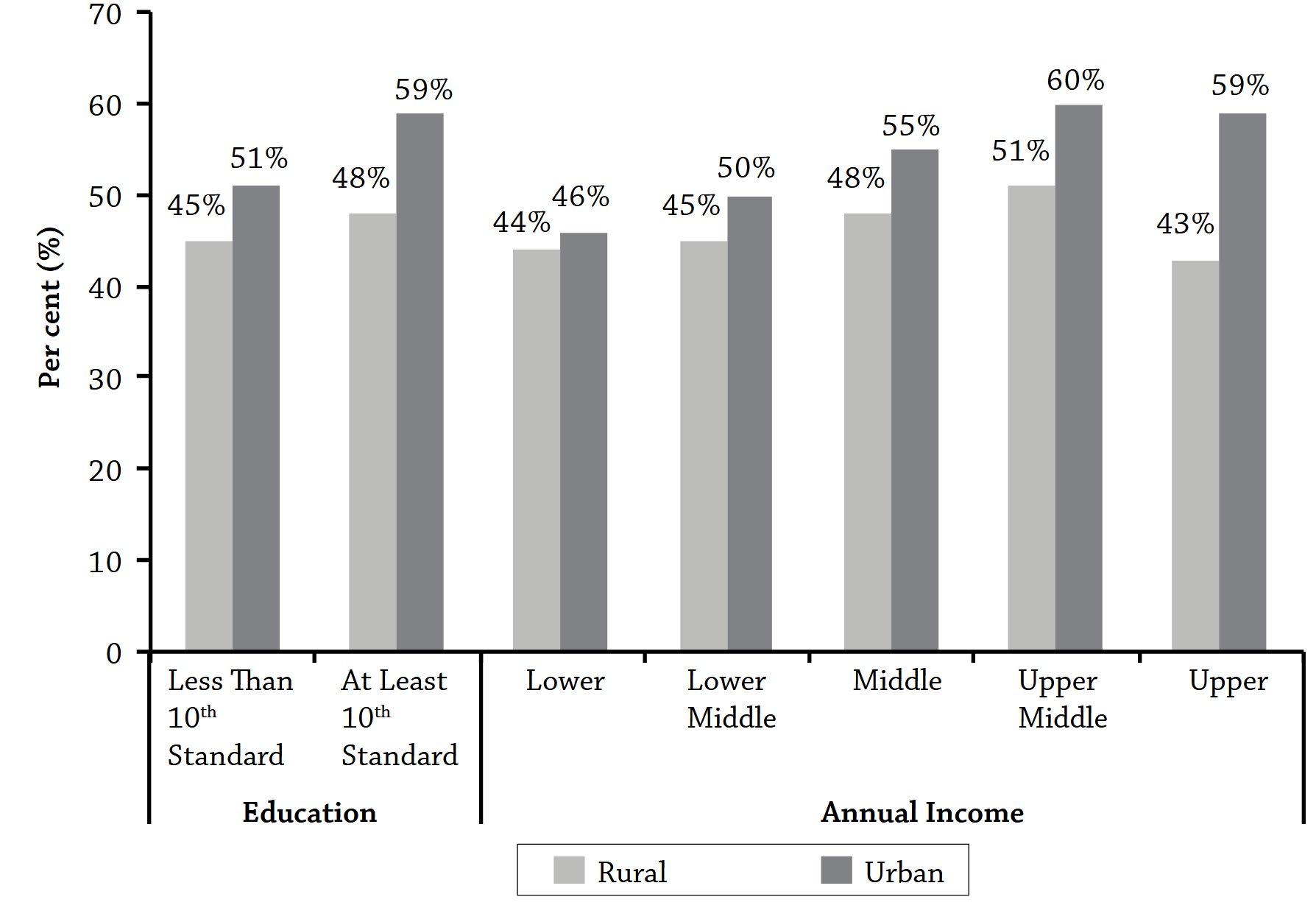
If so many Indians across household incomes consider themselves middle class, whom are political manifestos and news media referring to in schemes aimed at the middle class? More importantly, are voters aware of how their perceptions of economic classes compare with others’ perceptions?
These are questions I don’t have answers to. The stereotype of the economically privileged considering themselves to be middle class is well documented (at least in jokes/memes). But until this experience, I was not aware that this trend extended to lower income groups too.
If you haven’t already done so, I highly encourage you to check out the household income distribution in your country. Learning where I stood in my country’s income distribution has been a transformative experience—one that has permanently changed the way I look at myself and the world around me.
I would love to hear from you if you have any thoughts about my experience, insights regarding the questions raised here, or have a similar eye-opening experience to share.
Note: As the authors emphasise in their chapter, the results of the survey need to be interpreted with care. The chapter also examines the correlations of middle-class self-identification with social aspiration and economic optimism. I highly recommend checking it out.
*Name changed
The Importance of Being Middle Class in India. Carnegie Endowment for International Peace. Accessed April 14, 2025. https://carnegieendowment.org/posts/2017/11/the-importance-of-being-middleclass-in-india?lang=en ↩